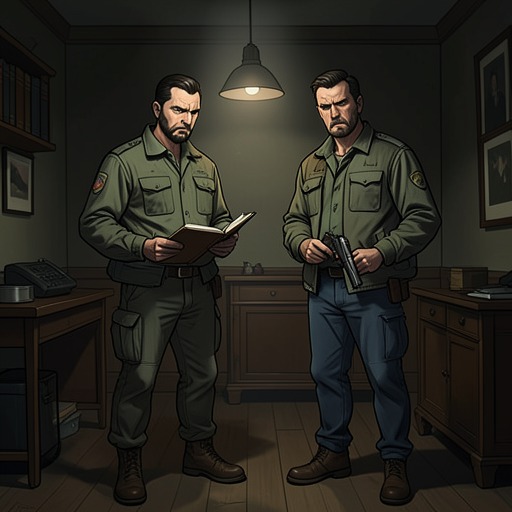
Augustus Landor and Ethan Hitchcock’s investigative partnership and disagreements
The Pale Blue EyeAugustus Landor and Ethan Allen Hitchcock’s investigative partnership is shaped by a recurring conflict between command and caution: Hitchcock demands an account of stalled inquiries, while Landor insists that suspicion is not yet proof. Their disagreements sharpen when Hitchcock questions Landor’s allegiance and points to Edgar Allan Poe as a possible person Landor is protecting. Yet the conflict does not end in a break. Faced with unresolved dangers and incomplete evidence, the two reach a practical arrangement that preserves both surveillance and Landor’s investigation.
Inquiry and Allegiance
Ethan Allen Hitchcock challenges Augustus Landor over the progress of his inquiries, naming specific gaps rather than offering a general reprimand. Landor has found no further evidence of satanic practices, has not located the supposed officer who persuaded Private Cochrane to abandon Leroy Fry’s body, and has held Leroy Fry’s diary for nearly a week without producing a clue useful to the case. The questions place Landor’s investigative record under pressure: the diary, a potentially important source, has not yet yielded the answer Hitchcock expects.
Landor begins to frame the dispute as one of competence, suggesting Hitchcock believes he is unfit to conduct the investigation. Hitchcock corrects him: his objection is not to Landor’s competence but to his allegiance. The shift makes the conflict personal and ethical. Hitchcock is not merely asking whether Landor has solved the case; he suspects that Landor’s loyalties may be interfering with what he is willing to investigate or disclose. Landor’s grinding teeth register the accusation as an immediate provocation, and he demands an explanation.
When Hitchcock raises Edgar Allan Poe, Landor responds with conspicuous confusion, though the narration lets the reader see the strain beneath that performance. Landor remembers Poe’s threat against a man on the Plain and tries to dismiss it as characteristic talk. Hitchcock counters with the crucial circumstance that the person Poe had threatened was found dead within twenty-four hours. The timing gives Hitchcock a concrete reason to suspect Poe, while Landor’s effort to minimize the threat makes his position seem less detached than his insistence on evidence would suggest.
Suspicion and the Standard of Proof
The disagreement over Poe exposes a difference in emphasis. Hitchcock treats the threat followed by a death as a reason to press the question of culpability; Landor argues that Poe’s words do not establish that he could have subdued Randolph Ballinger. The surviving exchange ends with Landor posing that challenge, not with Hitchcock accepting it. Their disagreement therefore remains unresolved in the moment: the threat is serious, but the available account does not establish how Landor ultimately evaluates Poe’s physical capacity or what conclusion Hitchcock draws from Landor’s response.
Later, Hitchcock asks why the suspected pursuer followed Landor beyond the reservation and why the same man, if it was the same man, would try to kill him on one occasion but leave him unconscious on another. Landor offers possibilities rather than a settled explanation: there may be a second man who can restrain the first, or the attackers may be trying only to frighten him. The exchange shows that their investigation depends on hypotheses that neither man can yet prove. Hitchcock seeks an explanation for the apparent inconsistency; Landor keeps multiple possibilities open while the evidence remains incomplete.
That caution also governs Landor’s opposition to arresting Artemus Marquis. Hitchcock asks how they can delay if Landor truly believes Artemus is involved. Landor answers that belief is not enough: in the New York practice he invokes, an arrest requires cold evidence. He reviews what they have—the priest’s collar, blood on Joshua Marquis’s uniform, and the witnesses’ limited view of a bar—and argues that none securely identifies a culprit. The collar is inconclusive without a priest; the blood could belong to anyone, even someone wounded at the Battle of Maguaga; and Private Cochrane and Asher Lippard cannot reliably identify the uniform from what they saw. The inventory does not clear Artemus. It explains why Landor thinks a premature arrest could fail to hold.
Personal Risk and Unequal Attention
The partnership is not confined to evidence and procedure. Landor has told Hitchcock about close calls in Artemus’s closet and outside Benny Havens’ tavern, but he later reflects that Hitchcock did not ask after his health or express concern for his safety. In Landor’s account, Hitchcock is absorbed by the message in the events, not by the person who carried it. That distinction gives their cooperation an austere quality: Landor brings the danger into the room, while Hitchcock turns first to what it means for the case.
Hitchcock’s attention to the investigation is explicit in his questions about the pursuer’s purpose and in his concern that Artemus may be involved. The narrative does not establish that he is indifferent to Landor as a person; it shows Landor expecting sympathy and registering its absence. That perspective matters because the scene is narrated by Landor, whose personal danger and frustration shape the contrast he draws between messenger and message. Their working relationship is close enough for Landor to report these incidents and debate their meaning, but not so reassuring that he feels personally protected by Hitchcock’s response.
Compromise and Continuing Cooperation
Landor eventually explains why he is delaying action: a missing piece, he says, will make the case fall into place, while acting before it is found will leave the evidence incoherent and the result unsatisfactory to everyone involved, including Hitchcock, Colonel Thayer, and the president. This is not a claim that the evidence already proves his suspicions. It is an argument for waiting until the case can be made to cohere and withstand scrutiny. Hitchcock does not simply abandon his concern, but the two negotiate a limited compromise.
Hitchcock agrees to have someone who is not a fellow cadet discreetly track Artemus’s movements. The surveillance is intended to help secure the cadet corps without compromising Landor’s inquiries. Hitchcock does not tell Landor whom he will assign, and Landor does not ask; the omission establishes a boundary within their cooperation, allowing the measure to proceed without making Landor responsible for its details. The arrangement answers Hitchcock’s demand for action while preserving Landor’s insistence that an arrest must wait for stronger evidence.
Their final exchange keeps the partnership active rather than resolving its distrust. Hitchcock asks for the next installment of Leroy Fry’s diary the following morning. The request returns their dispute to its original practical problem: the diary is in Landor’s possession, and the investigation still depends on what it may reveal. Hitchcock and Landor leave the confrontation with surveillance underway, Artemus not yet arrested, and the decisive piece still missing. Their collaboration survives through negotiated procedure, not settled confidence.